Doomscrolling: Emotion-Triggered Interaction & Compulsive Engagement in Social Media Feeds
Course: Affective Human Computer Interaction, MS HCC
Overview:
Process & Contributions:
Investigated how emotional states and platform design interact to sustain compulsive scrolling behavior, commonly known as doomscrolling, among young adults. The project combined a mixed-methods diary study with qualitative interviews to capture naturalistic, real-time engagement patterns that laboratory studies typically miss.
1. Research Design & Framing
Grounded the study in Höök's Affective Loop framework and the concept of normative dissociation, the narrowed, absorbed attention state that weakens users' ability to recognize when to stop scrolling.
Identified a critical gap in existing literature: most prior work relied on cross-sectional or lab-based methods, leaving real-time emotional engagement in everyday contexts understudied.
Developed two research questions addressing how young adults experience doomscrolling (RQ1) and how emotional tipping points and platform features drive it (RQ2).
2. Data Collection - Three Phase Diary Study
Recruited 8 participants (ages 18-28) via convenience sampling using a screener for daily social media use.
Phase 1: Pre-study questionnaire establishing baseline mood and compulsive scrolling tendencies (using Sharma et al. scale).
Phase 2: 7-day diary study participants filled out a Google Form after each scrolling session, logging intended vs. actual duration, platforms used, emotional state (Likert scale), and a quick reflection.
Phase 3: Post-study semi-structured interview with 8 questions probing patterns observed in diary entries and reflecting on the experience of self-monitoring.
3. Analysis
Applied descriptive statistics to quantitative diary data (intended vs. actual scroll time, mood ratings before and after scrolling).
Conducted inductive thematic analysis on qualitative interview responses to surface emergent patterns across participants.
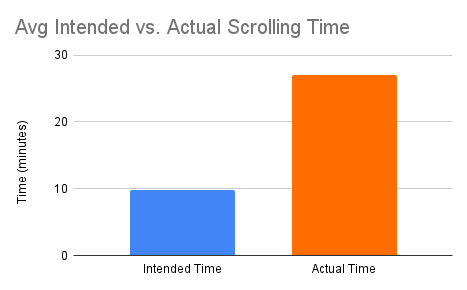
Avg Intended vs. Actual Scrolling Time
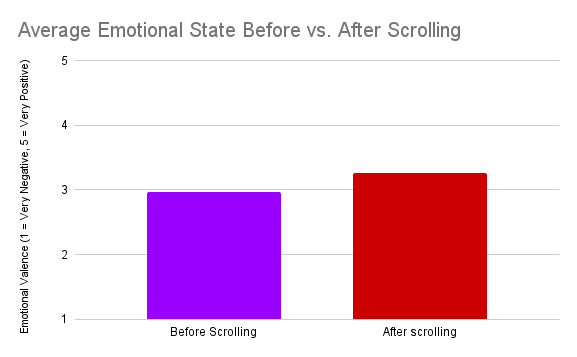
Average Emotional State Before vs. After Scrolling
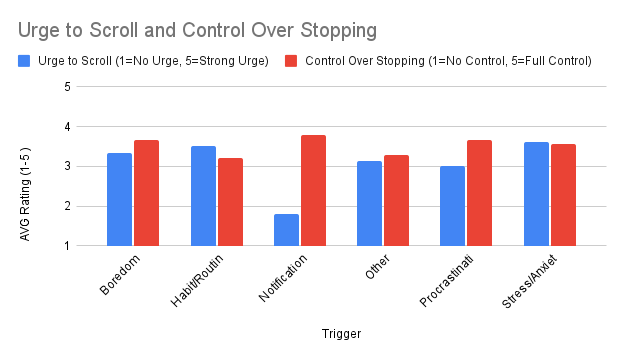
Urge to Scroll and Control Over Stopping
Outcome & Impact:
Actual scrolling sessions lasted nearly 3× longer than participants intended, revealing a consistent "time blindness" tied to habit, stress, and nighttime routines.
Average mood shifted slightly more positive after scrolling, yet participants reported mixed emotional outcomes, suggesting scrolling functions as short-term emotional regulation with longer-term costs.
Self-monitoring as intervention: 7 of 8 participants reduced their scrolling simply by being aware they had to log their sessions, a lightweight accountability nudge that disrupted the compulsive loop.
Identified morning and bedtime scrolling as highest-risk windows, and task avoidance as a key driver, users escaped to social media from stressful tasks, prolonging sessions and amplifying stress.
Findings point toward actionable design interventions: restoring stopping cues, surfacing elapsed-time feedback, and supporting user agency within platform design.